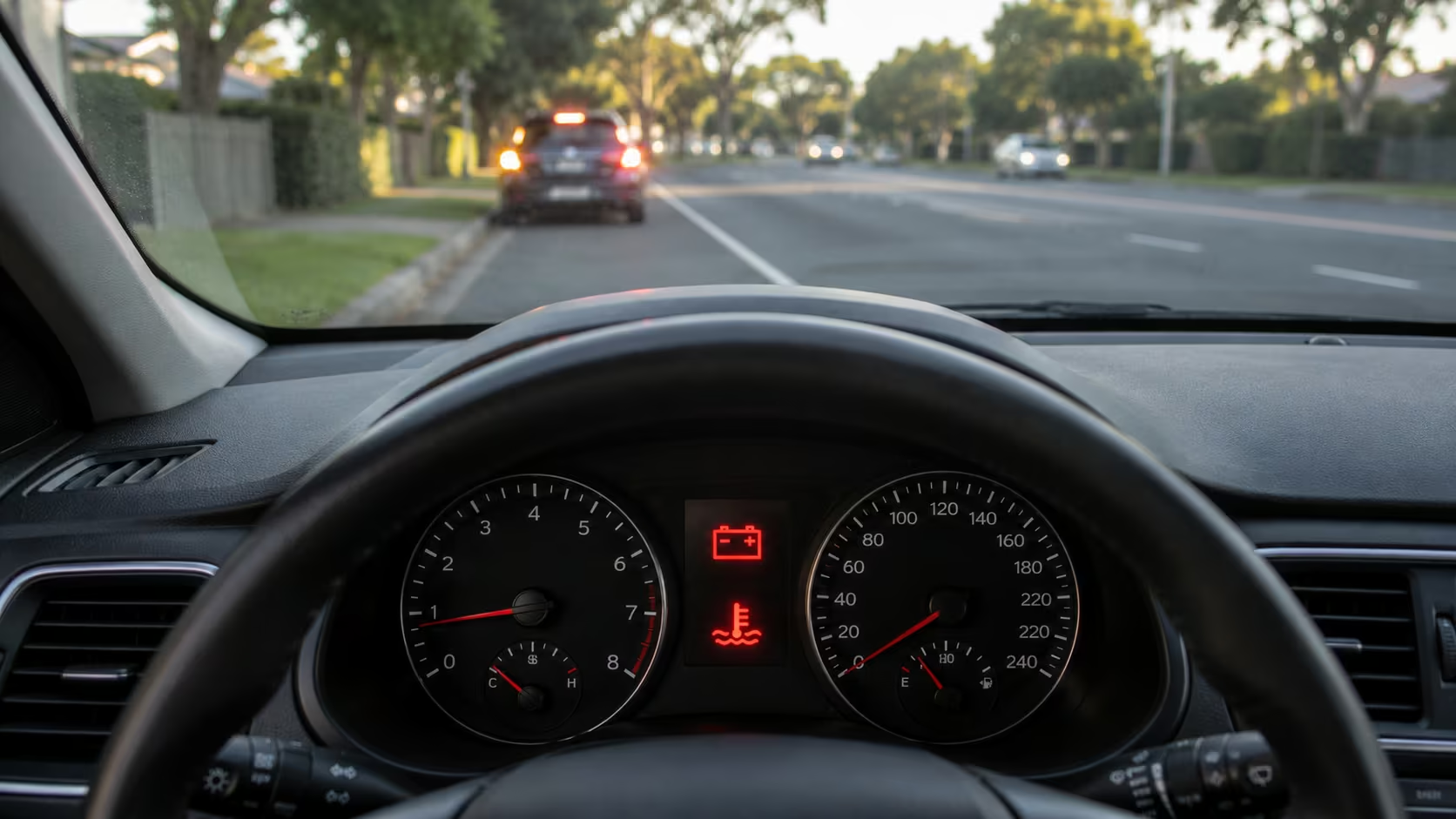
The battery light does not indicate that the battery has failed; it indicates that the charging system has stopped charging. The engine is now running solely on stored power, usually because the alternator has failed, the drive belt has broken, or a cable has failed. Expect a limited window before the car shuts down completely.
The picture on the dash is a battery so owners purchase a battery and a fortnight later the same light is shining at them from behind the same steering wheel. It’s one of the most costly misreads in motoring, and it boils down to a symbol that marks the wrong bit. That’s what the light is really telling you. What to do in the next few minutes and the one thing that will turn this from an inconvenience into a stop the car now situation.
Call Now
The Light Reports Charging Not the Battery
An engine that is running should not be living off its battery at all. A belt driven from the engine turns the alternator, which generates the electricity that the car uses when it is running and at the same time recharges the battery. The battery’s real job is short and specific: to fire the starter motor, then get refilled. The rest is the shift in the alternator.
The warning lamp is actually watching the difference between what the alternator is putting out and what the system should see. That output is gone, the lamp lights up, and the proper name for it is a charging system warning. The battery below might be alright. Only now is the sole source of power in a car using electricity faster than it can be replenished.
How Far You Can Drive Once It Comes On
Less far than you would like, and the range is wide enough that guessing is unwise. A healthy battery in daylight, with the stereo off and no heating running, might keep a car going for a reasonable stretch of suburban driving. The same car at night, in rain, with headlights, wipers, demister and heater all drawing hard, can be down to minutes. A battery that was already tired before any of this started gives you less again.
The ending is not gentle either. As voltage sags, modern cars misbehave in order: the dash starts lighting up with unrelated warnings, systems drop into reduced function, the engine can stumble as ignition and fuel electronics lose their supply, and finally it stops and stays stopped. The useful way to think about the light is as a countdown of unknown length that started the moment it appeared.
What to Switch Off and What Not to Switch Off
Stretching the window is simple: stop spending. Turn off the stereo, the air conditioning, the heated seats and rear demister, and anything charging from a USB port. Keep only what safety demands, headlights after dark, wipers in rain, indicators when you need them. Every load you kill buys distance.
The counterintuitive half is the ignition. Resist the urge to switch the engine off at a servo or a shop to think things over, because restarting is by far the biggest single drain a battery ever faces, and a car with nothing recharging it may simply not start again. If the engine is running and you have somewhere sensible to be, keep it running and go there. Parking is a decision that can be made for you, permanently, by one unnecessary restart.
Battery Light Plus Temperature or Heavy Steering Means Stop
This is the pairing that changes everything. On many cars a single belt drives the alternator and the water pump, and on vehicles with hydraulic steering it turns that pump too. If that belt snaps or comes off, the alternator stops charging and the water pump stops circulating coolant at the same instant, so the car is now heading toward overheating while the dash quietly blames the battery.
The signs arrive together and fast: the battery light comes on, the steering suddenly needs real effort on cars with hydraulic assistance, and the temperature gauge begins climbing within a few minutes. That combination is not a drive it home situation. Pull over as soon as it is safe and switch off, because continuing to run an engine with no coolant circulation does damage measured in cylinder heads, and it does it quickly. A battery light on its own is a countdown. A battery light with heat or heavy steering is an alarm.
Alternator Failure and the Noises That Precede It
Not quite as far as you’d like, and the range is wide enough that guessing would be unwise. A healthy battery in daylight with the stereo off and no heat running could get a car a good distance through suburban driving. Same car at night, in rain, with headlights, wipers, demister and heater all drawing hard, can be down to minutes. A battery that was already tired before any of this began gives you less again.
And the ending is not gentle. Modern cars misbehave in order as the voltage sags . Dash lights start flashing with unrelated warnings, the systems drop into reduced function, the engine can stumble as ignition and fuel electronics lose their supply, and finally it stops and stays stopped. The useful way to think about the light is as a countdown of unknown length that began when it appeared.
Cables, Terminals and the Fusible Link
Not every charging failure is a failed part. The alternator’s output has to travel to the battery through a heavy cable, and that cable is protected by a fusible link or a high current fuse, which can blow and end charging while leaving a perfectly healthy alternator bolted to a perfectly healthy engine. Corrosion or looseness at the connections does the same job more gradually. These are the cheap endings to this story, and they are also why the low voltage that follows can set off warning lights in completely unrelated systems, filling the dash with faults that all evaporate the moment proper charging returns.
Two Pieces of Advice Worth Ignoring
The first is the old workshop trick of pulling a battery terminal off while the engine runs to see whether the car keeps going. On a car built decades ago it proved a point. On anything modern it invites a voltage spike through electronics that cost more than several alternators, and no diagnosis is worth that risk. A meter across the battery, or a proper charging system test, answers the same question without gambling the car’s computers.
The second is the belief that a jump start fixes this. Jump starting a car whose charging system has failed gets the engine running and nothing else, and it will die again once that borrowed energy is spent, which is the difference between this and the flat battery most people are picturing. What separates the two, and identifies which of the causes above you are actually dealing with, is a charging system test on the battery, alternator and wiring together, measured rather than assumed.
If That Light Is On Right Now
Kill the electrical loads, leave the engine running, and bring it straight in while it is still moving under its own power, because a car that arrives driving is a repair and a car that arrives on a truck is a repair plus a tow. A to Z Automotive Services tests the whole charging circuit before anything gets replaced, so nobody sells you an alternator that a corroded cable end was imitating, and nobody sells you a battery that was never the problem in the first place.
Frequently Asked Questions
I put a new battery in and the light came back. Why?
Because the light was never reporting the battery. It reports the charging system, and a new battery fitted to a car that is not charging simply gives you a fresh reservoir to drain. The alternator, its belt, or the cabling between them is where the answer lives.
Can I keep driving once the battery light appears?
Only far enough to reach somewhere sensible, and only if nothing else has joined it on the dash. You are running on stored power with no resupply, so the question is not whether the car will stop, it is where. Choose the where while you still can.
Should I turn the engine off if I stop for fuel or a shop?
Preferably not. Restarting takes a serious bite out of a battery that has nothing refilling it, and a car that shut down happily can refuse to wake up. If you can leave it running while you sort what you need, or better still keep driving to the workshop, do that instead.
Can a loose belt cause the light to flicker rather than stay on?
It can. A belt slipping intermittently produces charging that fades in and out, so the light flickers, often worst at idle or under heavy electrical load, and clears when revs rise. Flickering is an early warning rather than a lesser one, and it is the cheapest moment to act.