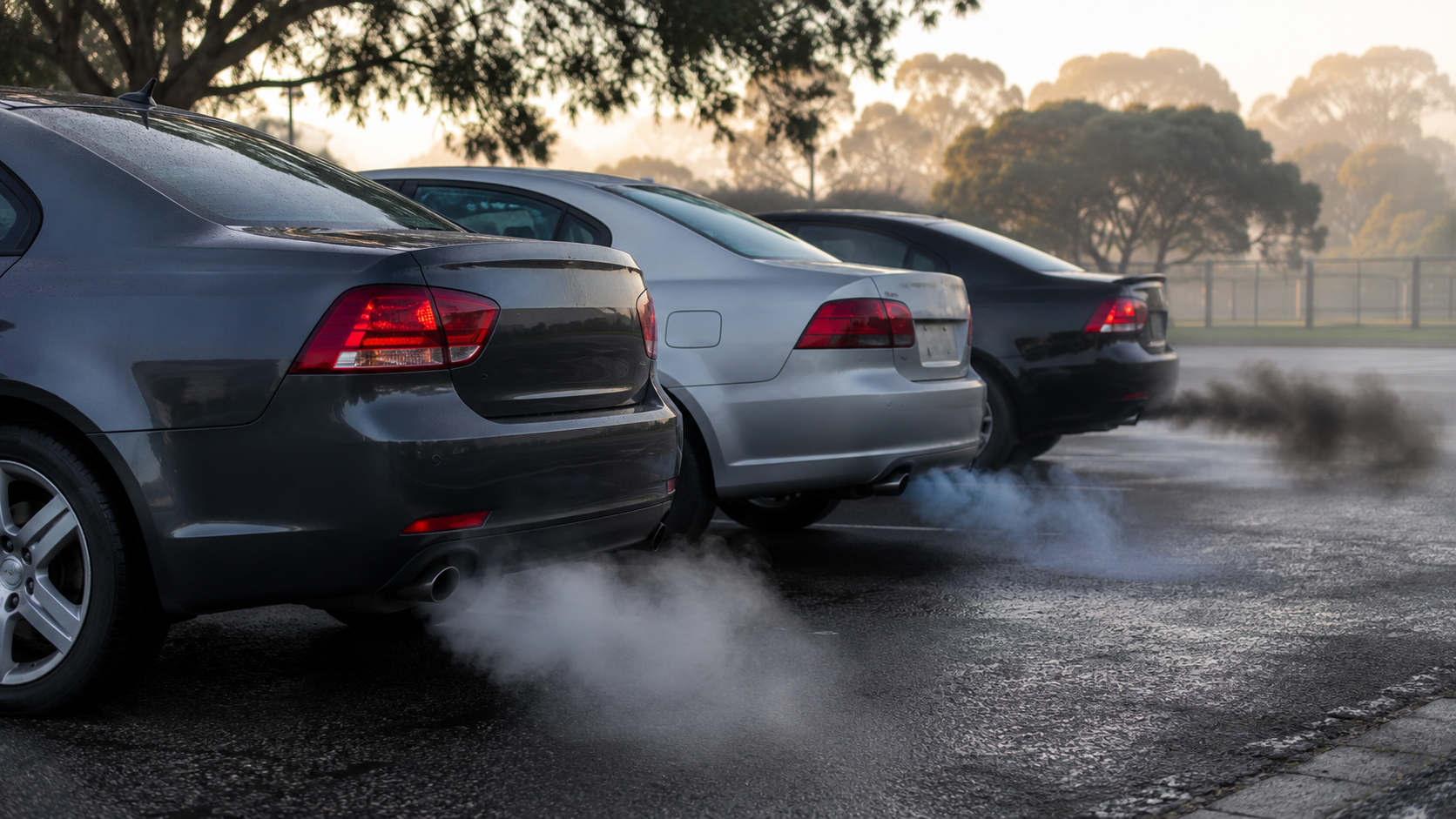
Thick white exhaust smoke usually means coolant is entering the combustion chamber, blue or grey smoke means the engine is burning oil, and black smoke means it is burning too much fuel. Thin white vapour on a cold morning is condensation and completely normal. The colour identifies the system, and the timing narrows the cause.
Exhaust smoke is one of the few faults a car announces in a language anyone can read, provided you know the vocabulary. Three colours, three completely different systems, and a set of clues in when the smoke appears that will get you most of the way to the cause before a workshop opens the bonnet. Here is how to read your own tailpipe, starting with the version that panics people for no reason at all.
Call Now
Thin White Vapour on a Cold Morning Is Not Smoke
Most white exhaust searches end here, and they end happily. Burning fuel produces water, water condenses in a cold exhaust system overnight, and the first few minutes of running boil it back out as visible vapour. On a cold Newcastle morning, especially a damp one, you get a plume behind the car that looks alarming and means nothing whatsoever.
The test is dissipation. Steam thins and disappears within a metre or two of the tailpipe, fading as the exhaust warms through, and by the time you reach the end of the street it has stopped. Real smoke behaves differently: it hangs in the air, drifts as a visible cloud, and does not care how warm the engine is. If your plume vanishes as quickly as it appears and only shows up on cold starts, the car is fine and the rest of this post is reading for interest rather than concern.
Thick White Smoke Means Coolant in the Combustion Chamber
Now the version that matters. White smoke that stays thick after the engine is fully warm, hangs in the air behind the car, and carries a faintly sweet smell is coolant being burnt inside the engine. It arrives there through a failed head gasket, a cracked cylinder head, a crack in the block, or on some engines a failed oil cooler or EGR cooler letting coolant into places it was never meant to reach.
The supporting evidence sits under the bonnet. Coolant that keeps dropping with no puddle underneath is the classic partner to this symptom, because the missing fluid is leaving through the exhaust rather than onto the driveway. Bubbles rising in the expansion tank while the engine idles, a temperature gauge that has started reading higher than it used to, and heating that has turned unreliable all point the same direction.
Worth separating this from the other way coolant announces itself, because they are different failures with different repairs. Coolant escaping into the cabin or the engine bay produces that sweet smell without any exhaust smoke at all, and that family of faults sits at a much friendlier price. Sweet smell plus white smoke plus disappearing coolant is the combination that needs looking at this week rather than next month, because a head gasket driven on gets worse in a hurry and takes the cylinder head with it.
White Smoke on a Diesel Can Also Be Unburnt Fuel
Diesels add a possibility petrol owners never meet. White or pale grey smoke from a diesel can be raw fuel passing through the engine unburnt, usually because an injector is failing, or because compression in a cylinder has dropped far enough that combustion is incomplete. The engine typically runs rough alongside it, and the smoke smells sharply of diesel rather than sweet.
That smell distinction does most of the work. Sweet points at coolant and a gasket or a crack. A raw diesel smell points at fuelling or compression, an entirely different investigation with an entirely different bill. Two clouds that look identical from the driver’s seat, and thirty seconds standing behind the car tells them apart.
Blue or Grey Smoke Means the Engine Is Burning Oil
Blue tinged smoke has one meaning: engine oil is getting into the combustion chamber and burning alongside the fuel. The smell is heavy and slightly acrid, the smoke has a bluish grey cast in daylight, and the confirming evidence is on the dipstick, because an engine burning enough oil to show at the tailpipe is an engine whose level drops noticeably between services.
Where the oil comes from is the real question, and there are four regular answers. Valve stem seals harden with age and let oil seep down into the cylinder while the car sits. Piston rings and cylinder walls wear until they no longer seal properly. Turbocharger seals fail and feed oil straight into the exhaust stream. And a blocked crankcase ventilation system builds pressure that pushes oil where it does not belong, which is the cheapest item on that list by a wide margin and the one worth ruling out first.
When the Blue Smoke Appears Narrows the Cause
This is where owners can genuinely help their own diagnosis, because each source has a signature moment. A puff of blue on start up that clears within a minute and does not return points at valve stem seals, since oil has been quietly draining past them while the car was parked. Blue smoke that appears under acceleration and load points at piston rings and bore wear, the pressure of hard running forcing oil past a seal that has stopped sealing.
Blue on deceleration, coming off the throttle after a good run, points back toward valve guides and seals, drawn by the vacuum a closed throttle creates. Blue from a turbocharged car that shows up on boost or right after a hard drive, with no other engine symptoms, points at turbo seals. And blue that is simply there all the time, at every speed and every temperature, generally means wear that has progressed past the point of subtlety. Noting which of those matches your car before you book it in is worth real money in diagnostic time.
Black Smoke Means Too Much Fuel or Too Little Air
Black smoke is unburnt fuel, soot leaving the engine because combustion had more fuel than it could burn or less air than it needed. On a petrol car the usual suspects are a leaking or failing injector, an airflow sensor reporting nonsense, a fuel pressure regulator letting through more than it should, a coolant temperature sensor convincing the computer the engine is permanently cold and needs a rich mixture, or something as ordinary as an air filter that has not been changed in years.
The side effects tell the same story from another angle. Fuel consumption climbs, the engine may idle roughly or hesitate, and there is often a strong fuel smell around the car. Running rich is not merely wasteful either: excess fuel washes lubricating oil off the cylinder walls and dumps unburnt fuel into the catalytic converter, so the cheap sensor that caused it can end up funding a far more expensive exhaust repair if it is left alone.
Black Smoke on a Modern Diesel and the DPF Connection
Diesels have always been the black smoke specialists, and on an older one a brief puff under hard acceleration was part of the character. Modern diesels are different, because a particulate filter sits in the exhaust specifically to catch soot, so visible black smoke from a car fitted with one is a genuine signal rather than a quirk. Something upstream, injectors, a boost leak, a struggling turbo or an EGR fault, is producing more soot than the system was built to handle, and the filter fills far faster than it should while that continues.
That is the part worth understanding for anyone driving a modern diesel. Black smoke is not just a fuelling fault, it is a fuelling fault actively shortening the life of an expensive exhaust component while you watch. Fixing the cause early is considerably cheaper than fixing the cause and the filter together, which is the bill that arrives if the smoke gets ignored for a year.
Which Smoke Colours Need Acting On Today
Ranked honestly: thick white with a sweet smell and dropping coolant is the urgent one, because overheating and a warped head are the next chapters. Persistent blue is serious but slower, an engine steadily consuming itself while coating its own exhaust in ash. Black is the least immediately dangerous and the most quietly expensive, since it wastes fuel every kilometre and loads the DPF the whole time. Thin white vapour on a cold start needs nothing at all. Where the colour is ambiguous, or two of them seem to be present, a proper diagnostic session with a compression or leak down test settles it in a morning, and settles it before the engine has an opinion of its own.
Getting Smoke Looked At Before It Gets Expensive
Take a short phone video of the smoke next time it appears, note whether it happens cold, hot, on acceleration or coming off the throttle, and hand both over when you arrive, because that thirty seconds of footage regularly saves an hour of chasing. A to Z Automotive Services would rather watch your video and run a compression test than sell you a guess, so book it in while the smoke is still occasional, and if the culprit turns out to be a crankcase ventilation valve or a neglected air filter rather than the engine rebuild the internet promised you, expect to hear that plainly and pay accordingly.
Frequently Asked Questions
Is the mayonnaise under my oil cap proof of a head gasket?
No, and this one causes a lot of needless panic. A creamy deposit under the cap is often just condensation from short trips that never let the engine fully warm through, common in winter. It becomes meaningful when it turns up alongside white exhaust smoke, coolant loss, or a milky look on the dipstick itself.
Why does my car smoke on cold mornings but not later in the day?
Because that is almost certainly water vapour rather than smoke. Condensation gathers in the exhaust overnight and boils off once the system heats up, which is why it appears at start, thickens in cold weather, and vanishes after a few minutes of driving.
Can burning oil damage anything besides the engine?
Yes, and it is the part owners forget. Oil passing through the exhaust coats the catalytic converter and, on diesels, loads the particulate filter with ash that never burns off. A modest oil burning problem left running long enough turns into an exhaust bill on top of the engine one.
Does a bit of black smoke on hard acceleration mean my diesel is faulty?
On an older diesel, a brief puff under heavy load has always been fairly ordinary. On a modern diesel with a particulate filter, visible black smoke is not ordinary at all, because the filter exists precisely to catch it, and smoke escaping means something upstream is producing more soot than the system was designed to handle.