Ever been hit with a quote for a timing belt replacement and thought, “Is that actually fair, or am I being taken for a ride?” You are not alone. It is one of the most common questions we hear at our workshop here in Cardiff, Newcastle, and honestly, the answer is never as simple as a single number.
After replacing thousands of timing belts on everything from everyday Toyotas to high-end BMWs and Audis, we can tell you this: the cost varies a lot depending on what you drive, what parts are used, and how much work is involved. But we can also tell you exactly what goes into that price so you can judge for yourself whether a quote is fair.
Call Now
What Is a Timing Belt and What Does It Actually Do?
Consider your engine as an orchestra. “You have got pistons going up and down and valves opening and closing and everything has to happen at the exact right time. The timing belt is the maestro. It helps to keep the camshaft and crankshaft in perfect sync in your engine . So the valves open and close at the right time as the pistons move .
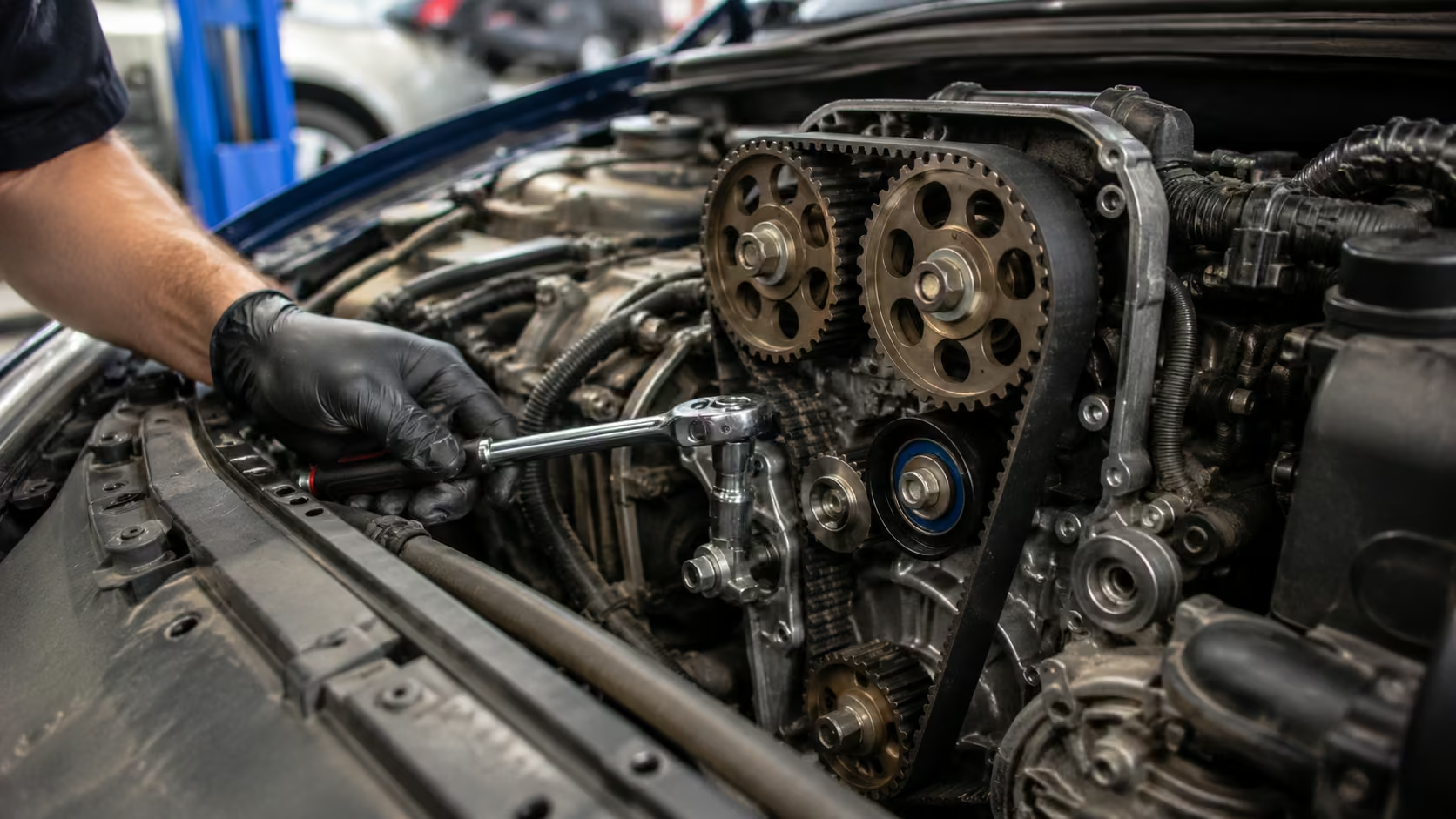
It’s a rubber belt with teeth on it that sits behind a cover at the front of your engine. You can’t see it without taking stuff apart and that’s part of the reason this job costs what it does.
Here’s the scary part: if that belt breaks while you’re driving, the valves and pistons could hit each other. In most modern engines (interference engines) that means bent valves, damaged pistons, and potentially a completely ruined engine. We’ve seen timing belt failures turn a $900 repair into a $6,000 engine replacement. It’s not something you want to play the casino with.
How Much Does a Timing Belt Replacement Cost in Australia?
For most cars on Australian roads, a timing belt replacement will cost somewhere between $600 and $1,500+. That is a wide range, we know. But the price depends on three main things: parts, labour, and the type of car you drive.
Parts Cost
The belt itself is actually one of the cheaper components. A quality timing belt might cost $50 to $150 depending on the brand and your vehicle. But here is the thing, no good mechanic will just replace the belt on its own. A proper timing belt replacement should include:
- The timing belt itself
- Tensioner (the spring-loaded device that keeps the belt tight)
- Idler pulleys (guide the belt along its path)
- Water pump (on many cars, it is driven by the timing belt and sits right behind it)
When you add all of that together, the parts bill usually sits between $200 and $600. European cars tend to be at the higher end because OEM parts from manufacturers like Volkswagen, BMW, and Audi simply cost more.
We always recommend using quality branded parts (genuine or OEM equivalent) for this job. You might save $100 up-front by buying a cheap no-name timing belt kit, but if a bargain belt snaps at 40,000 km instead of lasting the full service interval, that saving disappears very quickly.
Labour Cost
This is where most of the money goes. And rightly so. The timing belt replacement isn’t a quick job. For a simple four-cylinder engine, like in a Toyota Camry or a Hyundai i30, it will take about 3 to 4 hours. On a European car like an Audi A4 or BMW 3 Series you are looking at 5 to 8 hours or more.
Why take so long? Because the belt is deep inside the engine. To get to the timing belt your mechanic has to remove engine covers, the serpentine belt, sometimes the radiator or engine mount, pulleys and whatnot. When fitting the new belt the engine timing must be set correctly otherwise if it is even one tooth out the engine will not run correctly or could be damaged.
You’re not paying somebody to change a rubber band. You are paying for the skill, the experience, and the accuracy that keeps your engine alive.
At normal Australian workshop labour rates ($100 to $180 per hour depending on location and specialisation) the labour component alone can cost anywhere between $300 and over $1,000.
European Cars vs Japanese and Australian Cars
If you drive a European car, be prepared to pay more. This is not a scam. It’s the reality of how these engines are just designed. European manufacturers tend to put more complicated engines in tighter engine bays. This means more parts have to be removed before you can even see the timing belt.
For example, a timing belt job on a Volkswagen Golf or Audi A3 with the 2.0L TDI engine will usually cost more than the same job on a Mazda 3 or Toyota Corolla. The parts cost more, the labour takes longer and the job often needs specialist tools that general workshops may not possess.
That said, the benefit of going to a European car specialist rather than a generic chain workshop is that we’ve done these jobs hundreds of times. We know the shortcuts that save time without cutting corners and we have the right tools already.
Timing Belt Replacement Cost by Car Brand
Here is a rough guide to what you can expect to pay in Australia based on the make of your car. These are estimates for a full timing belt kit replacement (belt, tensioner, idler pulleys, and water pump where applicable):
| Car Brand | Estimated Cost Range (AUD) |
| Toyota / Mazda / Hyundai / Kia | $600 – $1,000 |
| Subaru (Impreza, Forester, Liberty) | $700 – $1,200 |
| Holden / Ford (older belt-driven models) | $600 – $1,000 |
| Volkswagen / Audi | $900 – $1,500+ |
| BMW | $1,000 – $1,800+ |
| Mercedes-Benz | $1,000 – $1,800+ |
| Porsche (Cayenne, older Boxster) | $1,200 – $2,500+ |
A few things to keep in mind with these numbers. They are general guides, not fixed quotes. The exact cost depends on the specific model, engine type, year, and what condition the surrounding components are in. If a mechanic finds a leaking oil seal while they have the belt off, that adds to the job but it is far better to fix it now than to pay full labour again later.
Subaru owners in particular should pay attention here. Models like the Impreza, Forester, and Liberty with the boxer engine are known for needing timing belt replacements at around 100,000 km. The boxer layout makes the job a bit more involved than a standard inline engine, which is why the cost tends to sit slightly higher than other Japanese brands.
Timing Belt vs Timing Chain: Does Your Car Even Have a Belt?
Before you start worrying about timing belt replacement costs, it is worth checking whether your car actually has a timing belt at all. Many modern cars use a timing chain instead.
The difference is straightforward. A timing belt is made of rubber with reinforced teeth. A timing chain is metal, similar to a bicycle chain but much more heavy-duty. Chains generally last longer and in many cases are designed to last the life of the engine, although they can stretch over time and need replacing too.
Cars that commonly use timing belts:
- Most Subarus (Impreza, Forester, Liberty, Outback with the EJ engine)
- Older Toyotas (Camry, Hilux with certain engines)
- Volkswagen / Audi (1.8T, 2.0 TDI, 2.0 TFSI)
- Older Hyundai and Kia models
- Honda (Accord, CR-V with certain engines)
- Some older BMWs and Mercedes models
Cars that commonly use timing chains:
- Most modern Mazda models (SkyActiv engines)
- Toyota (most newer models)
- Most modern BMWs (N20, B48 engines)
- Holden Commodore (V6 and V8)
- Most modern Hyundai and Kia models
- Nissan (most models)
If you are unsure, check your owner’s manual or give your mechanic a quick call. We are always happy to look it up for you if you tell us the make, model, year, and engine type.
When Should You Replace Your Timing Belt?
Most manufacturers recommend replacing the timing belt every 60,000 to 100,000 km or every 5 to 7 years, whichever comes first.
That second part is important and catches a lot of people out. Even if you have only done 40,000 km, if your car is 7 years old, the timing belt should be inspected or replaced. Rubber degrades over time regardless of how much you drive. Heat, cold, humidity, and just sitting there all take their toll on the belt material.
Your logbook or owner’s manual will have the exact recommended interval for your specific car. If you have lost the manual, we can look it up based on your vehicle details.
Here are some common intervals for popular cars in Australia:
- Volkswagen / Audi 2.0 TDI: Every 120,000 km or 5 years
- Subaru EJ engine (Impreza, Forester): Every 100,000 km or 5 years
- Toyota Camry (older 4-cyl): Every 100,000 km or 6 years
- Hyundai Tucson / i30 (older models): Every 90,000 km or 5 years
If the previous owner did not keep records and you are not sure when it was last done, it is always safer to replace it. The cost of a new belt is a fraction of the cost of fixing a snapped one.
Warning Signs Your Timing Belt Needs Replacing
Here is the honest truth: most of the time, a timing belt gives you zero warning before it fails. That is exactly why sticking to the scheduled replacement interval is so critical.
That said, there are a few things you might notice if the belt is on its way out:
A ticking or slapping noise from the engine. As the belt wears or loosens, it can start making a rhythmic ticking or light slapping sound coming from behind the engine cover. It is different from a squealing serpentine belt, so if you hear something unfamiliar, get it checked.
Engine misfires or runs rough. If the belt has stretched and jumped a tooth on the camshaft sprocket, the engine timing will be slightly off. You might notice the engine running rough, hesitating, or misfiring under load.
Visible cracks or wear (if inspectable). On some cars, a mechanic can partially inspect the belt by removing a small cover. If you can see cracks, fraying, missing teeth, or a glazed shiny surface, it is time for a replacement.
Oil leaking near the timing cover. Oil leaks from the front of the engine can contaminate the timing belt. Oil-soaked rubber deteriorates much faster and can cause the belt to slip or break prematurely.
The car will not start. If the belt has already snapped, the engine will crank but will not fire. At that point, you are hoping it is a non-interference engine. If it is an interference engine (and most modern cars are), the damage is already done.
The takeaway? Do not wait for warning signs. Follow the service schedule. It is the cheapest insurance you will ever buy.
What Happens If You Do Not Replace Your Timing Belt?
We do not say this to scare you, but because we have seen it happen too many times: ignoring your timing belt replacement schedule is one of the most expensive mistakes you can make as a car owner.
If the belt snaps on an interference engine (which is the majority of modern cars), the pistons and valves occupy the same space in the cylinder at different times. The timing belt keeps them from colliding. Without it, the pistons slam into open valves.
The result? Bent valves, cracked pistons, damaged cylinder head, and sometimes a completely destroyed engine. We have seen repair bills from $3,000 for a cylinder head rebuild go all the way up to $8,000 or more for a full engine replacement. On some European cars, a new engine can cost more than the car is worth.
If the belt snaps on a non-interference engine (less common these days), the pistons and valves do not collide. The car just stops running. You are stranded, but the engine is usually undamaged. You still need a tow and a timing belt replacement, but you dodge the catastrophic repair bill.
Either way, spending $600 to $1,500 on a scheduled timing belt replacement is a bargain compared to what happens if you skip it. It is one of those jobs where prevention truly is better (and much cheaper) than the cure.
Should You Replace the Water Pump at the Same Time?
On many cars, the water pump is driven by the timing belt and sits behind it. That means your mechanic has already done 90% of the labour to access the water pump when they are replacing the timing belt. Fitting a new water pump at the same time might add $100 to $250 to the parts bill, but it saves you from paying another $500 to $1,000+ in labour if the water pump fails a year later and you need to pull everything apart again.
Water pumps are a wear item. The bearings and seals degrade over time. If your car has done 100,000 km and the timing belt is due, the water pump has done the same 100,000 km. Replacing it at the same time is just common sense.
We always recommend it to our customers, and most experienced mechanics will include it in their timing belt replacement quote as standard. If a workshop quotes you for a timing belt without mentioning the water pump, ask them about it. A good mechanic will explain why it makes sense to do both together.
How to Save Money on Your Timing Belt Replacement (Without Cutting Corners)
We get it. Nobody enjoys paying for car repairs. But a timing belt is not the job to cheap out on. Here are some smart ways to keep the cost down without risking your engine:
Get multiple quotes, but compare like for like. Ask each workshop what is included in the quote. Are they replacing just the belt, or the full kit (belt, tensioner, idler pulleys, water pump)? A $500 quote that only covers the belt and labour is not actually cheaper than a $900 quote that includes everything.
Ask about the parts being used. Quality brands like Gates, Dayco, Continental, and genuine OEM parts are what you want. If a workshop cannot tell you what brand of belt they are using, that is a red flag.
Do not delay past the recommended interval. The longer you wait past the due date, the higher the risk of a failure. A scheduled replacement at $900 is a lot better than an emergency engine rebuild at $5,000.
Choose the right workshop for your car. For European cars especially, using a specialist workshop that works on your brand every day means the job gets done faster and more accurately. We work on Volkswagen, Audi, BMW, Mercedes, and Porsche engines all day, so what might take a general mechanic 8 hours, we can often complete more efficiently because we have done the same job hundreds of times.
Avoid mobile mechanics for this job. Timing belt replacement requires a clean, well-lit workspace, the right tools (including torque wrenches and timing lock pins), and sometimes engine support fixtures. This is not a driveway job.
Why Timing Belt Replacement Costs More on European Cars
If you drive a European car and you have been quoted more than your mate with a Corolla, here is why that is completely normal.
Tighter engine bays. European manufacturers like BMW, Audi, and Mercedes tend to pack more technology into smaller spaces. That means more components need to be removed to access the timing belt, which adds labour time.
More complex systems. Many European engines use dual overhead cam setups, variable valve timing systems, and balance shafts that all interact with the timing belt system. Setting the timing on a VW 2.0 TDI or a BMW N47 is more involved than a simple single-cam setup.
Higher parts costs. Genuine and OEM-equivalent parts for European cars cost more. A timing belt kit for an Audi A4 2.0 TFSI is significantly more expensive than one for a Toyota Corolla, and for good reason. The engineering tolerances are tighter and the materials are higher-spec.
Specialist tools required. Many European timing belt jobs need specific locking tools, alignment pins, and fixtures that are unique to that engine family. General workshops may not have them, which either means they cannot do the job properly or they need to source the tools first.
At A to Z Automotive, we specialise in European cars. We have the tools, the parts knowledge, and the hands-on experience to get the job done right the first time. That is not marketing talk. It is just what happens when you work on the same engine families year after year.
Getting Your Timing Belt Replaced in Newcastle and Lake Macquarie
If you are in the Newcastle, Lake Macquarie, or Hunter region and your timing belt is due, we would be happy to help.
At A to Z Automotive Services, we are based at 74 Mitchell Rd, Cardiff NSW 2285. We have been servicing European and all other makes for over 15 years, and timing belt replacements are one of our most common jobs. Whether you drive a Volkswagen Golf, a BMW X3, a Subaru Forester, or a Hyundai Tucson, we have done the job on your engine before.
Here is what you get when you bring your car to us for a timing belt replacement:
- A full timing belt kit (belt, tensioner, idler pulleys) using quality branded parts
- Water pump replacement recommendation included in every quote
- All work carried out by experienced technicians who specialise in your type of vehicle
- Transparent pricing with no hidden costs
- A comfortable waiting lounge with complimentary drinks, snacks, massage chair, and pool table if you want to wait while we work
You can call us for a quote or book your timing belt replacement online. We will tell you exactly what your car needs and what it will cost before we start any work.
Frequently Asked Questions
How much does it cost to replace a timing belt in Australia?
A timing belt replacement in Australia typically costs between $600 and $1,500 or more, depending on your vehicle. Smaller Japanese and Korean cars tend to sit at the lower end, while European cars like Volkswagen, Audi, BMW, and Mercedes usually cost more due to higher parts prices and more complex labour requirements. A full timing belt kit replacement (including tensioner, idler pulleys, and water pump) is always recommended over replacing the belt alone.
How long does a timing belt replacement take?
For most standard four-cylinder cars, a timing belt replacement takes around 3 to 5 hours. For European cars or more complex engine layouts (like Subaru’s boxer engine), the job can take 5 to 8 hours or longer. The time is mostly spent accessing the belt (removing covers, mounts, and other components) and then precisely setting the engine timing when fitting the new belt.
Can you drive with a bad timing belt?
Technically, the car will keep running until the belt actually snaps. But once it does, the damage happens instantly. On interference engines (which most modern cars have), a broken timing belt can cause the pistons to hit the valves, resulting in thousands of dollars in engine damage. There is no safe way to “nurse” a worn timing belt. If it is overdue, get it replaced as soon as possible.
Will a timing belt last 10 years?
Most manufacturers recommend replacing the timing belt every 5 to 7 years, regardless of how many kilometres you have driven. Rubber deteriorates with age, heat, and exposure to engine chemicals. A belt that looks fine on a 10-year-old low-km car might be brittle and cracked internally. Sticking to the time-based interval is just as important as the kilometre-based one.
Is timing belt replacement worth it on an older car?
It depends on the overall condition and value of the car. As a general rule, if the car is worth more than $3,000 to $4,000 and is mechanically sound otherwise, replacing the timing belt is almost always worth it. If the car has other major issues (rust, transmission problems, high oil consumption), it might not make financial sense. We are always honest with our customers about whether a repair is worth doing, and we will tell you straight if we think the money is better spent elsewhere.